Lunch Reset
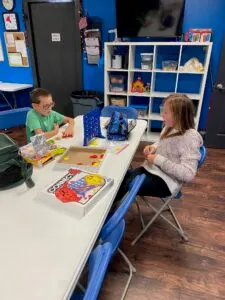
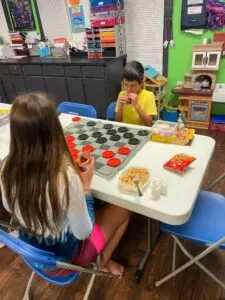
The Eagles have noticed that, during lunch, people were not cleaning and waiting for others to clean to go to free time. They were very frustrated and made an announcement about it. We made up some guardrails together to help better lunch time for them.At Active, lunch is a special, independent part of the day. We’ve slipped on this lately, with lunch turning into additional free time. Now’s our chance to refocus.Here are 4 potential guardrails for lunch:
- Lunch is for eating and conversation
- “Table games” are appropriate during lunch, like Chess, etc.
- Lunch cleanup must be complete before free time starts
- Happens in the lunch area
The Eagles agreed on these guardrails and hope that lunch time will be smoother.

Sally the Seller
During Quest time, the Eagles learned about Sally the Seller!
Sally the Seller: A Story about the Flow of Cash
Once upon a time, an artist named Sally decided to try to make some money from her work. She had saved up $12, which she carried with her in her pocket, but she decided that she wanted to take a risk to see if she could make this $12 grow. So she decided to make picture frames to sell at the outdoor market for local artisans to sell their goods.The first thing Sally did was go to the hardware store to invest in some tools. These were tools she knew she would use over and over but that she would only need to buy one time: a hammer and some paint brushes.The hammer cost $2 and the paintbrushes cost $1. She handed $3 over to the hardware store and took her hammer and paintbrushes. She considered these $3 to be sunk costs, because she had to pay them one time and was done with them, as if they had sunk to the bottom of the sea and been forgotten.Next, Sally bought enough materials to make one picture frame. She bought wood for $1, a glass pane for $1, nails for $1, and paint for $1. She handed this $4 over to the hardware store, too, but knew these costs were different than the sunk costs. Even though she could use the hammer and paintbrushes over and over again, no matter how many picture frames she made, Sally realized that if she decided to make more picture frames, she would need to return to the store to buy more wood, glass, nails, and paint. The amount of money Sally spent on these materials would keep going up and up the more and more picture frames she made, so she called these variable costs. Variable means “changeable,” and these costs would change whenever she changed the number of picture frames she made—the more frames she made, the more she’d have to pay for materialsSally went home and got to work—cutting wood, nailing it together, painting the frame, and inserting the glass. Finally, she was done—it was beautiful! And it was just in time for the weekly outdoor market.She went to the market and used her last $5 to pay the weekly booth fee. This was yet another kind of cost—she called it a fixed-period cost. This is a cost that is “fixed” —which is another way of saying that it stays the same for every “period,” or certain length of time. This cost would stay the same ($5) for the same amount of time each time she had to pay it—every week.So far she had spent $3 in sunk costs, $4 in variable costs, and $5 in fixed-period costs_—that was all of the $12 she had saved up! All this money leaving her pocket and none had entered it yet! Sally hoped her risk would be worth it.She set her beautiful picture frame on her table at the market with a price tag saying $16 and smiled at the customers walking by.All of a sudden, a woman named Betty, looking for a gift for her mother, came along and said she loved the picture frame! She had exactly $16 in her pocket, which she handed over to Sally. She left looking very pleased with her purchase. Sally, too, was pleased with this revenue._The Eagles learned about costs, risks and breaking even this week!
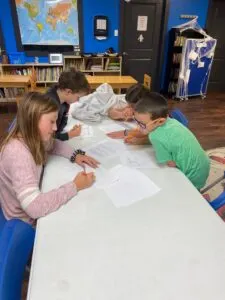
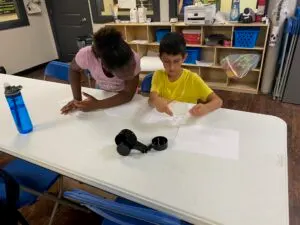
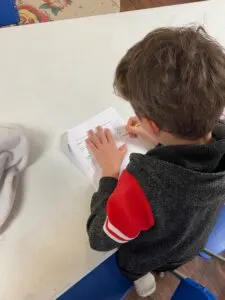
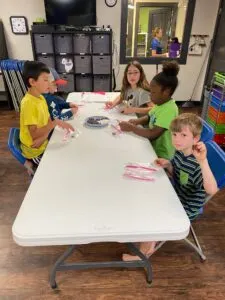
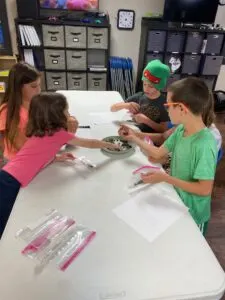
One of our Eagles brought in a special surprise to see if a brand name really mattered. We blindfolded the Eagles to see if they could tell the difference. He made homemade chocolate and had the Eagles try to compare it to Hershey’s chocolate.

Drafting about a Special Place You Love to Go
This week we read a mentor text called “All the Places to Love” by Patricia MacLachlan. We listened to the sentence fluency. We notice how this story reads almost like a poem. One of the reasons it reads this way is because of how well the author uses prepositional phrases. A preposition is a word that indicates location; it can be a physical location or a location in time. Words like “on” or “beside” or “during” are all examples of prepositions. A prepositional phrase is a phrase that begins with a preposition and ends with a noun. The noun is the object of the phrase, and the preposition is used to describe the location of the noun. Patricia MacLachlan uses creative and interesting prepositional phrases throughout her book. This is a tool that the Eagles can use to help them with their memoirs.


The Byzantine Empire
During a Socratic discussion this week, a question was posed after learning about the Nika riots that took place during the rule of Justinian in the Byzantine empire.
Is it okay to destroy homes?
What about businesses?
Community churches?
The post office?
The White House?
Is it ok to kill?
They went back and forth providing evidence and reasoning - changing their minds when someone presented new evidence/points of view.
This particular discussion took place during “Civilization” where instead of memorizing dates and names in history- we put ourselves in the shoes of real leaders making incredibly difficult decisions.
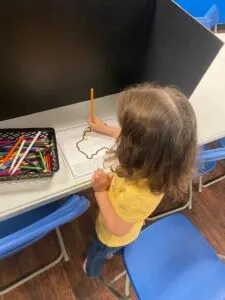
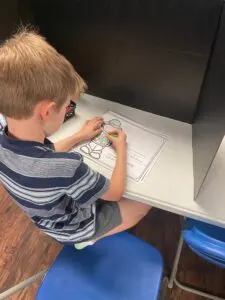
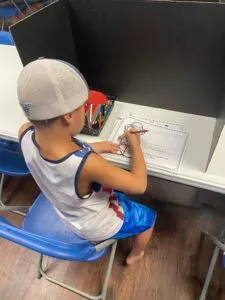
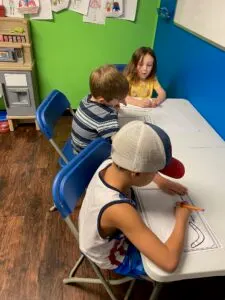
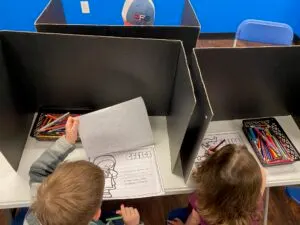
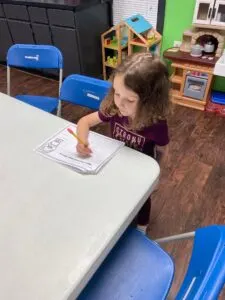
The little Eagles have their own civilization where they learn about different countries. This week, they learned about Australia and Greece. They love talking about the different countries and, at the end, they get together to write about what they learned.
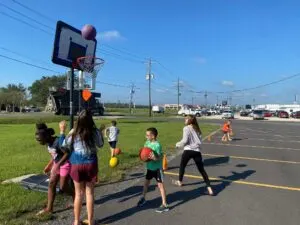
Goal Setting for P.E.
To pursue a lifetime of healthy physical activity, the Eagles…
- Have learned the skills necessary to participate in a variety of physical activities,
- Know the implications and the benefits of involvement in various types of physical activities,
- Participate regularly in physical activity,
- Are physically fit,
- Value physical activity and its contributions to a healthful lifestyle.